How do you describe your own art practice?
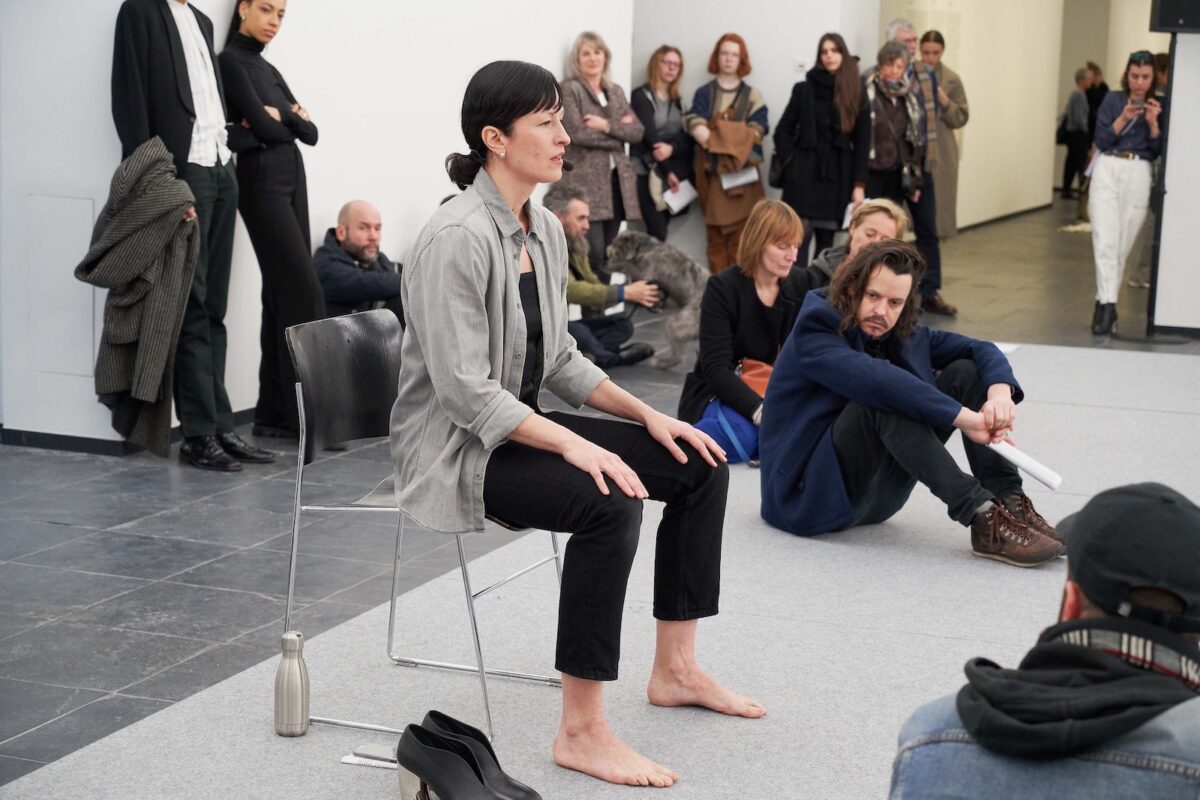
I am a choreographer mainly working in the medium of live performance. My work is rooted in dance, however I often work within visual arts contexts. I focus on audience perception and liveness, with a focus on live movement as well as sound. Occasionally I also work with photography and video.

Which question or theme is central in your work?
I am interested in the way ideologies manifest themselves on the level of our bodies, gestures and language. In particular, the predominant ideology of our time, namely neoliberal capitalism. What could a possible counter gesture be, in a system that incorporates all opposition? I am interested in daily movements, as well as the viral gestures and choreographies that circulate on the internet. In my work I try to examine the ideologies underlying these viral gestures, not only as a form of critique, but also using the analytical process as a way to generate new possibilities.

What was your first experience with art?
I grew up in an artistic family, my mom is an artist and my father is an architect. My mom took me to art galleries and museums before I could even walk. I basically grew up in her studio surrounded by art. But I do recall one of the first performances I saw when I was really young; it was by ‘The Clichettes’, a Toronto based feminist performance group that worked with lip syncing and choreography to parody feminine tropes in pop culture. I also saw a lot of installation art, painting and photography at the AGO (Art gallery of Ontario). My aunt is a photographer and my uncle is a writer, so I grew up with a lot of good books around and access to a dark room.

What is your greatest source of inspiration?
For a long time I was really influenced by pop music and its surrounding subcultures, as well as the dance cultures associated with them. I tend to take the term contemporary dance quite literally; I am very influence by actuality and emergent (movement) cultures and the ideologies they embody or counter. Currently I am looking towards social movements such as the mass protests occurring across the globe. I’m interested in particular in those movements and gestures associated with the collective body and resistance. What does the gesture of solidarity look like?
What do you need in order to create your work?
Staging dance can be quite heavy in terms of the resources, time and energy needed to put a piece together with many performers. It usually takes me a year or two to gather the resources I need to make a large scale performance. Which is why I occasionally work solo. It can be a relief to come back to my own body, and to make a direct link between thinking and embodiment. At the most basic level I require very little to create; a context to rehearse and perform. And an audience. Not much can happen if I don’t have an audience.

What work or artist has most recently surprised you?
Lee Lozano – I didn’t know her work beforehand. I was invited to perform ‘Relay’ a durational performance on the subject of protest involving a huge black flag, at the Pinacoteca Agnelli in Turin Italy this past spring. The invitation was through Office for Human Theatre, an itinerant research project by Italian curator Filippo Andreatta. The performance series took place in connection with Lozano’s retrospective, ‘Strike’. I couldn’t go to Turin myself, so I sent a performer to stage the piece; but I read a bit about her work and life. I finally saw the retrospective some months later at the Bourse de Commerce in Paris. I was struck by her humour and radical rejection of any form of classification or adherence to the trends of the day. In the end her work became more and more dematerialized, until she abandoned the art world altogether. This act was her ultimate artistic gesture.