How do you describe your own art practice?
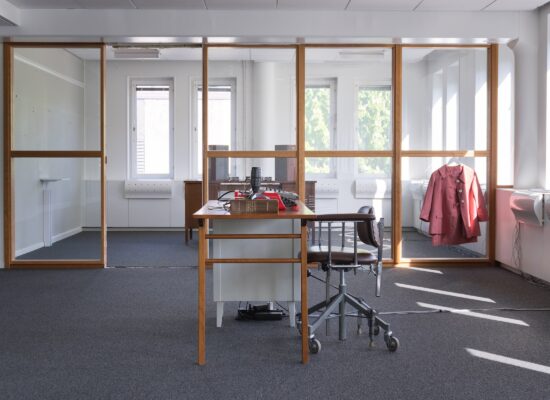
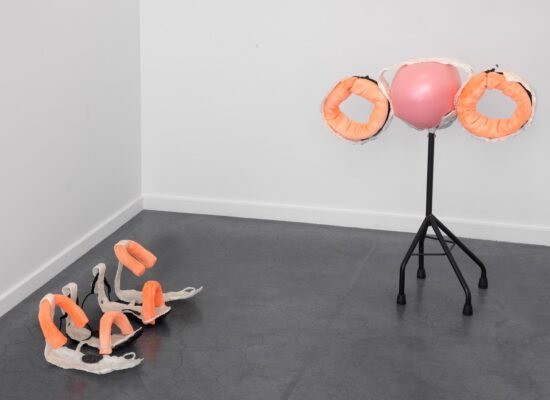
I try to create constructed situations and installations, interventions in public and gallery space, as well as studio-made objects and videos. I use both physically present material of “here and now” and moving image of “there and then”. My artworks can be described as “spatial situations” realized mostly through action, video, installation and object. I use an intermedia approach with a strong emphasis on plastic or spatial forms. However, rather than creating a fixed sculptural result, I set specific conditions for a situation to take place. I usually create apparatuses that reveal different or parallel images or set up constructed frameworks for a new specific activity. In this way, I act as both author and observer of my works at the same time.
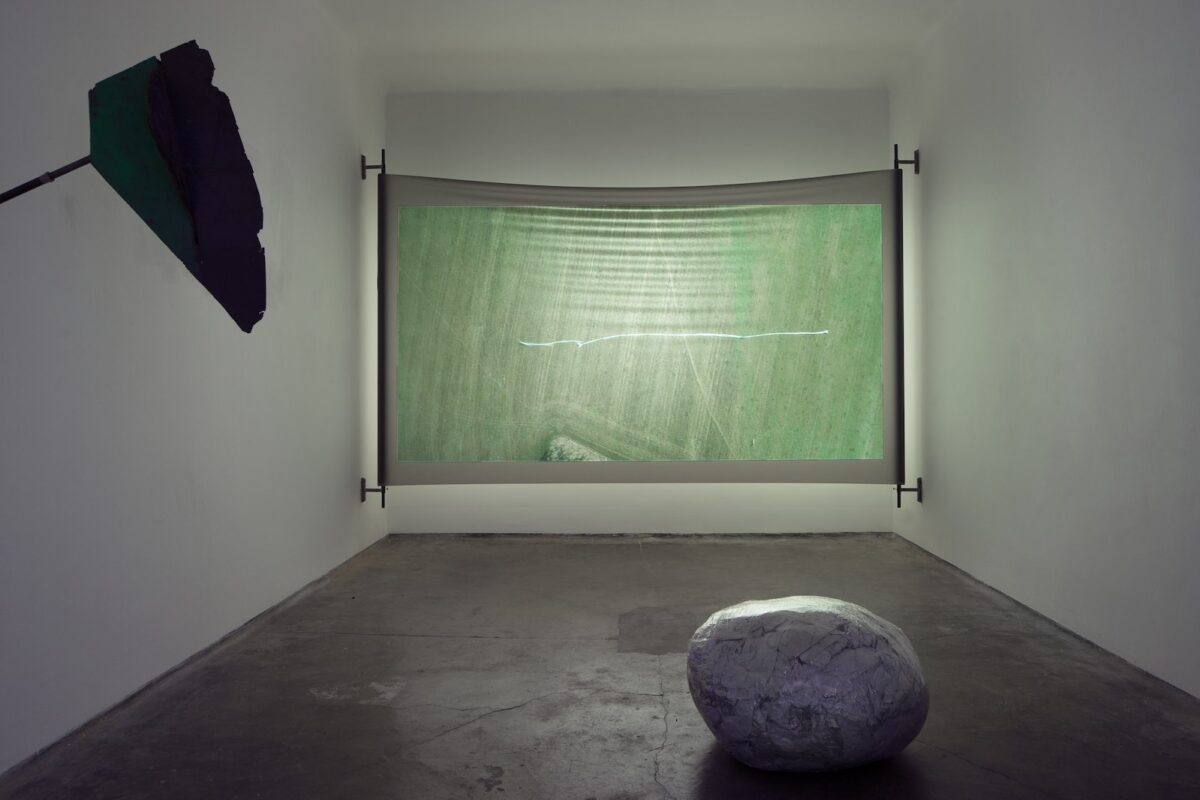
At SPZ Gallery Praha. Photo: Tomáš Souček
Which question or theme is central in your work?
One of the unifying motifs of my work is a change. Change can be understood as a natural quality, a production of time and space, but also as a conscious effort to deviate the routine perception of our surroundings. I am interested in that span of immediate reality, which appears to be stable, but has a potential of transformation at the same time My recent projects have turned into physical field research of places bearing specific signs of incompleteness. Selected places, caused by economic, ideological or social crises, have reached a state of “ruin-in-reverse”. Paradoxically, arrested progress has made the site a potential for future action. The failure of the originally intended plans can be described as a ‘crisis of vision’ which society must overcome by seeking future horizons.

What was your first experience with art?
From the visitor’s point of view, it must have been some first encounter with art at primary school. I still remember an exhibition of some obsessive ballpoint pen drawings of cave creatures that we visited with our class teacher (I don’t remember where it was or who the artist was). A relative of my family had quite a large wall collection of paintings that I loved to look at. At the age of seven I started attending an elementary art school, which gave me fairly regular exposure to the visual arts. Another very strong childhood memory is a chance visit to Jiří Příhoda’s Flood installation in Prague in 1996.

At Gare Maritime Brussel. Photo: Dáša Knerová
What is your greatest source of inspiration?
I would say it is the actual surroundings, space and some personal poetics that inspires me. I mostly start by observing the surrounding and the conditions where the work should be developed. I do research in terms of ongoing exploration of my long-term interest, following up on my previous works. In this respect my work is not directly research-based, even though it operates quite often in site-specific conditions. The work itself has mostly the form of video, installation or situation, but the exposition (show, screening, action) is the main form and also a medium of my works.

At Kunsthalle Praha. Photo: Vojtěch Veškrna
What do you need in order to create your work?
I need to encounter with a motif. Sometimes it is the invitation for a show itself, sometimes it is some strong element of public space I feel like to react on, or simply a personal vision. In every respect, I have to have this “encounter” as a trigger point, as a reason to make art which makes my motifs accessible for the others.

At Gare Maritime Brussel. Photo: Dáša Knerová
What work or artist has most recently surprised you?
Recently I came across the works by Anca Benera and Arnold Estefán. This artist duo creates artworks reacting on the transformation of the landscape caused by various agents. Among others, I would like to highlight their still ongoing project Debrisphere – Landscape as an extension of the military imagination.

At Gallery Rudolfinum Prague. Photo: Martin Polák