How do you describe your own art practice?
I’m a photographer working with a loose, expressive form of documentation that leaves room for subjective interpretations, embracing the suggestive and metaphorical potential of photographs. I’m interested in visually elusive subject matters – I’m often drawn to that which is hard to directly photograph; working into the limits and partiality of photographs.
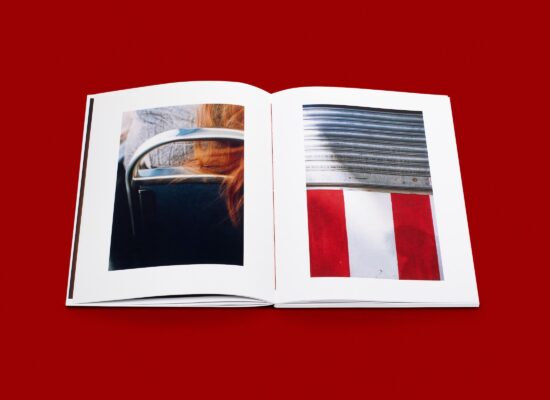
My practice is particularly concerned with photographs in book form. My first book, The Blindest Man, was published last year by VOID, and I was really interested in the different access points to the work you can create within book form. The work is based on the story of an unsolved treasure hunt, which gave me a playful structure in which to explore this; the book itself is a search.

Which question or theme is central in your work?
I’m fascinated with how we create meaning, and much of my work responds to that thematic in different ways; through belief, dreams, fantasy, subjectivity, communication, memory.
I’m also interested in the medium of photography itself. I’ve worked in different spaces across photography – as an editorial photographer, as an archivist, as a commissioning picture editor, as a producer for documentary/humanitarian photography, as a curator – and thus each of these roles or encounters has lead to thinking about the different ways in which images operate in the world – the promise and expectation of photographs versus the limitations and challenges of the medium.

What was your first experience with art?
I didn’t grow up around art; I’m from town in the centre of the UK where culturally there wasn’t much going on other than a very local music ‘scene’, and you had to travel to nearby cities if you wanted to visit an art gallery, see an arthouse film etc. I loved drawing and creative writing – and reading was really my transportation elsewhere. The first exhibition that I really remember was a Dali exhibition that we visited on a family vacation when I was around 12/13 – at the time the colour, the strangeness of the compositions, the heavy use of symbolism made an impression on me.
I became interested in photography when I was around 16 – school art classes were really restrictive and traditional so I started an evening course in photography. The tutor there introduced me to Tony Ray Jones, Nigel Shafran, Martin Parr – photographers who made work in response to the everyday – and I was immediately drawn to photography’s ability to transport and transform. At the same time I was working at the local library and came across Richard Billingham Ray’s A Laugh being sold off in one of the ex-library/old stock sales. I didn’t particularly like the photographs at the time, but as a book it was compelling, vivid, voyeuristic. I’ve come back to it over and over in the subsequent years – the book hinges around emotional distance and physical proximity, the structure of the book edit emphasises this – so it was really formative for me in terms of understanding what you can do with image editing.

What is your greatest source of inspiration?
Reading, collecting, walking, light – all of these usually play a key role in my work. Most of my work develops through a combination of reading, walking in the world with my camera, and getting excited about light. I love collecting (my partner calls it hoarding…) and I have files of postcards, images, old photographs and albums, news clippings, screengrabs which I come back to for inspiration or that I’ve collected with the idea that at some point I might return to it to make some work in response to.

What do you need in order to create your work?
Parameters. It may sound straightforward, but parameters, even arbitrary ones, help me to form and develop a body of work.
Sometimes restrictions or changes in circumstance can force new ways of working that are equally satisfying.

What work or artist has most recently surprised you?
Cyprien Gaillard’s exhibition Humpty / Dumpty at the Palais de Tokyo – for its expansiveness – the installations elegantly pull you from the micro to macro – exploring a multitude and subjects and references in a way that was not at all sentimental but at once deeply moving. His film Ocean II Ocean blew me away.