How do you describe your own art practice?
I use the lens of intersectionality to scrutinize the themes of isolation, memory, care, and bodily exhaustion through sculptures, performative acts, poetry, and drawings. I dwell on the nature of both my own and historical memory by seeking a unified view of human-constructed reality. I’m particularly intrigued by the factors that make us organize external phenomena in this particular way.
My actions always begin with the act of isolating, stretching, and molding my abstract personal archive. I see reality as continuous and infinite, rather than countable and categorizable. Intersectionality, which enables the potential for infinite change, allows me to see the expansion of boundaries in exhaustion and presence of brutality in care.

Which question or theme is central in your work?
Most recently, my work has focused on the concept of a personal archive. I view subjective memory as a latent set of abstract experiences which has a decisive influence on reality perceived by its carrier. It takes part in a unique mutual coating mechanism, protecting the ego through acts of selection and repression while also being protected by its bearer. These relationships are characterised by intimacy and delicacy of their surrounding shells, literally and figuratively. It functions much like a metaphoric personal archive, protected by a caring archivist.
Out of this system, a dormant agenda emerges directly in the present, struggling to suppress a smaller subset of memories impossible to assimilate. It is tied to how affirmative processes force individuals to create an infinite feedback loop inside them, becoming at once the consumer (boss) and producer (worker) of their own “self-development”; this is a dangerous position that can lead to an infinite demand and an inevitable final crash, by a slow blurring of internal possibilities with external demands.
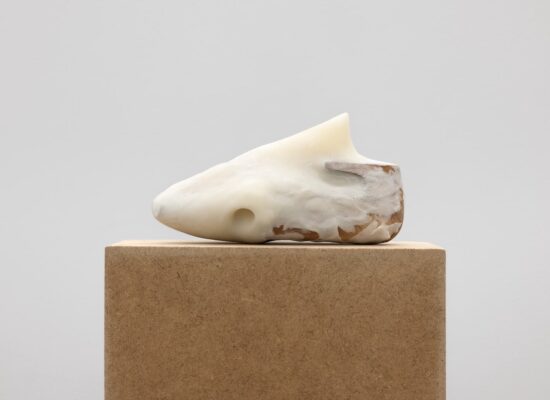
To examine and understand these conditions, I try to reanimate a space of alertness and neutrality. I use human milk to produce fabrics present in my works, evoking a long-lost dream of vitality, a contemporary relic of society based on the immunity principle. My works probe the forced elasticity of an individual, coerced into an endless consumption of stimuli and information promising to help them achieve the ever elusive self-betterment. With minds overflowing with facts and plans of possible futures, no space is left for their memories. The “present” permeates reality, pushing out melancholy, a feeling tied to the feelings of past loss. Nothing can be truly “lost” because nothing was truly “owned”.

What was your first experience with art?
That would be encountering family keepsakes of my great-grandfather—a colorist working in a pre- and post-war Warsaw workshop specializing in painted, custom-made wallpapers. I remember the plethora of samples, colors, and various paper textures that my mother kept as small mementos. This may be a stretch, but I think that this experience of sensory awe had a profound impact on me when, a decade and a half later, I instinctively turned towards being an artist. Now, after years of working with metal, I feel the urge to return to this intimate area once again by turning to paper, soft fabrics, and gentle colors.

What is your greatest source of inspiration?
I find comfort in open, stranded spaces like the sea, but also in non-places such as airports or train stations. Archives, poems, and live conversations are always a great source of stories for me, but in reality, I encounter inspiration in random places: it can be a fleeting event or a glimpse of an object, and sometimes it’s as elusive as a brief reflection of light. I always try to stay alert and witness as much as I can. Since my practice is so inextricably linked with memory, but also with themes of exhaustion, I observe my embodied experiences and cognitive signals very closely, becoming my own retina.

What do you need in order to create your work?
The first stage of my work is always a sketch, a note, a tiny model that allows me to get started. This phase is unique because of its delicacy and variability that requires peace and a safe, quiet space. I think this contrasts with the fact that, for me, the creative process is undefined, pushes me out of my comfort zone, and is, in a way, unpleasant; I try to carefully balance these two states to retain an ability to express what I am thinking about.

What work or artist has most recently surprised you?
Recently, I read DMZ Colony, a book by Don Mee Choi. I was very intrigued by the way she works with the fabric of memory: both collective and personal. Choi shows that memory—especially when it concerns trauma and history passed down by others—is always indirect, fragmentary, and open to re-translation. For me, this was a completely new way of understanding memory; this awareness of its limits and uncertainty have proved a great inspiration.
“It will sound like a lie… I know it sounds like a lie… I won’t say what they did to me, I’ll leave it up to your imagination…”[1]
[1] Don Mee Choi, DMZ Colony (Seattle: Wave Books, 2020)