How do you describe your own art practice?
I work with textile craft as a way of exploring kinship, change and flexibility.
I’m curious about textile materials and their everyday use, texture and adaptability. I’m drawn to studying, mixing, layering, and translating them into abstract weavings and assemblages of found objects.

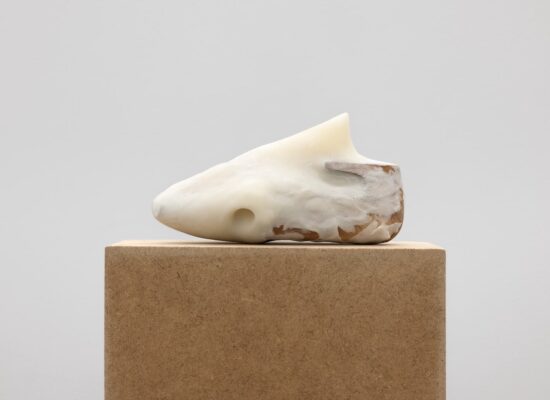
2021
60 x 60 x 30 cm
Wood fiber isolation, found wood, paper string, transfer print, tar,
Which question or theme is central in your work?
I work with themes of change and uncertainty through my own proximity to bodies that are transforming and gradually losing function. I keep returning to textiles because they stretch, wear and give way as well.
Through the found materials I work with, I try to stay with what is usually set aside— the worn, the domestic, the minor, the imperfect, the hand-touched, the disappearing.
My practice moves slowly. It wiggles its way forward through open-ended exploration. In a time that values efficiency, polish and seamlessness, I see this slowness as a way of staying with what is difficult rather than turning away from it.
For me, it creates space for a quiet attentiveness — a tactile way of being present, where I try to hold both solace and resilience.

2025
85x120 cm
Viscose, cotton, shrinking yarn
What was your first experience with art?
My experience with art has developed gradually and intuitively over time.
My mother encouraged me to study art in high school, but at the time it didn’t feel like a safe choice, as I was navigating a turbulent period for my family. So I took a “safer” path and built a career in sustainability within textile production. After several years, I felt the need to work more directly with materials and retrained in textile art.
This was about ten years ago, and around the same time, as I learned to weave, my mother decided to set up her old weaving loom from the 1970s, which she hadn’t used in thirty years. Since then, I’ve helped her with setting up her weaves as it can be quite labor-intensive. Dishcloth by dishcloth—her preferred project—this has become a small way of acknowledging her encouragement to pursue art.

11 x 15 cm
Fishing line, linen, transfer print
What is your greatest source of inspiration?
The material itself—both personal and cultural. I often find it in inherited items, second-hand shops, or digital archives of everyday textile objects. I go through these collections guided not by completeness, but by visual resonance, emotional pull, and traces of use and stories that the objects carry.

2023
100 x 300 cm
Raw silk, cotton, mohair
What do you need in order to create your work?
Experimentation time with materials to think through the process of making, as well as sharing ideas and making textiles with others.

2021
60 x 60 x 60 cm
Wood fiber isolation, found plank, paper string
What work or artist has most recently surprised you?
At Olga de Amaral’s recent exhibition at Fondation Cartier in Paris, I was deeply struck by the sensory experience—the materiality, the colors, and the spatial presence of and around the works. I walked around the exhibition several times, reluctant to leave the experience behind.

2023
100 x 300 cm
Raw silk, cotton, mohair