Based in Berlin, Germany
Website https://lorenbritton.com
Research project Algorithms & Slimes
Location Rupert Residency, Vilnius
Can you describe your research project?
Algorithms & Slimes is an ongoing research project between Ren Loren Britton & Goda Klumbytė that becomes active and lays dormant akin to the movements of slime molds that we research. When the field is fertile, we action again, when other pressures become more present – the project is dormant. In Algorithms & Slimes we have been fascinated by the ways in which more-than-human creatures like slime molds move, behave, organize, become dormant and reactivate. Other than the ways that humans currently behave which prioritize colonial modes of extraction, efficiency, optimization and categorization – which we find algorithmic logics to largely follow – Slime Molds as our teachers evade human forms of recognition / categorization and pose critical questions to us about how technologies might enact otherwise forms of relation. And inform for us ways of relation that are about reorganizing our priorities away from survival of the fittest or winning – rather they teach us about collaboration, cohabitation, decomposition, processing and emerging only when the conditions are right for transformation.
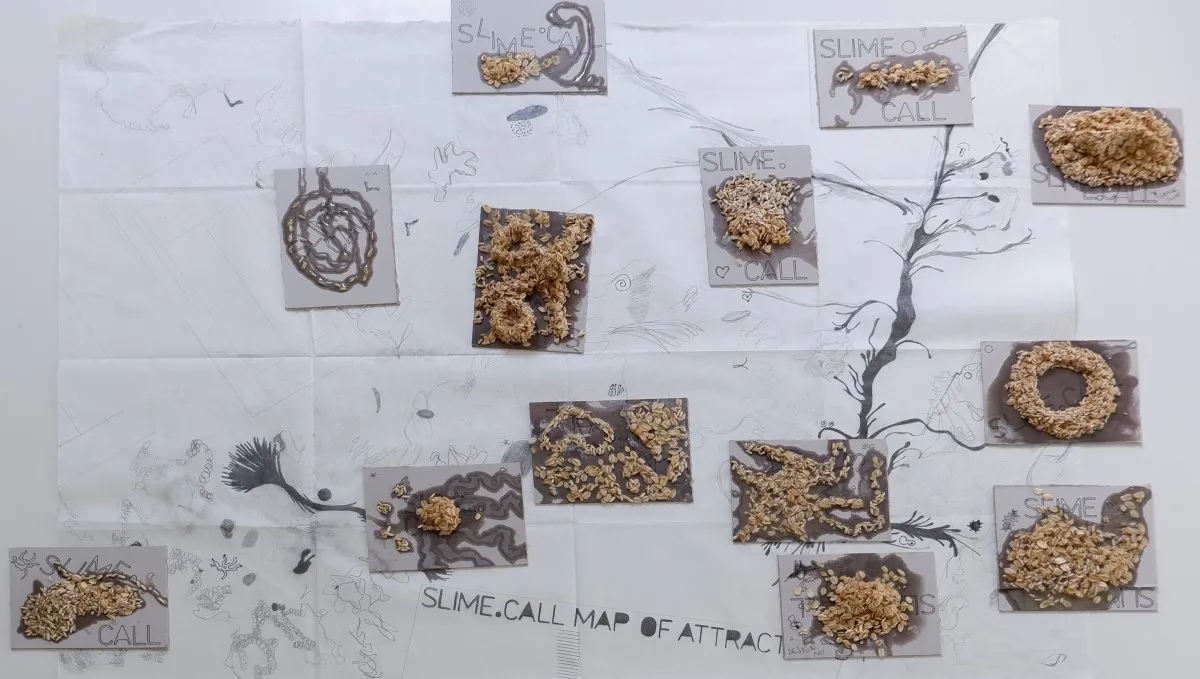
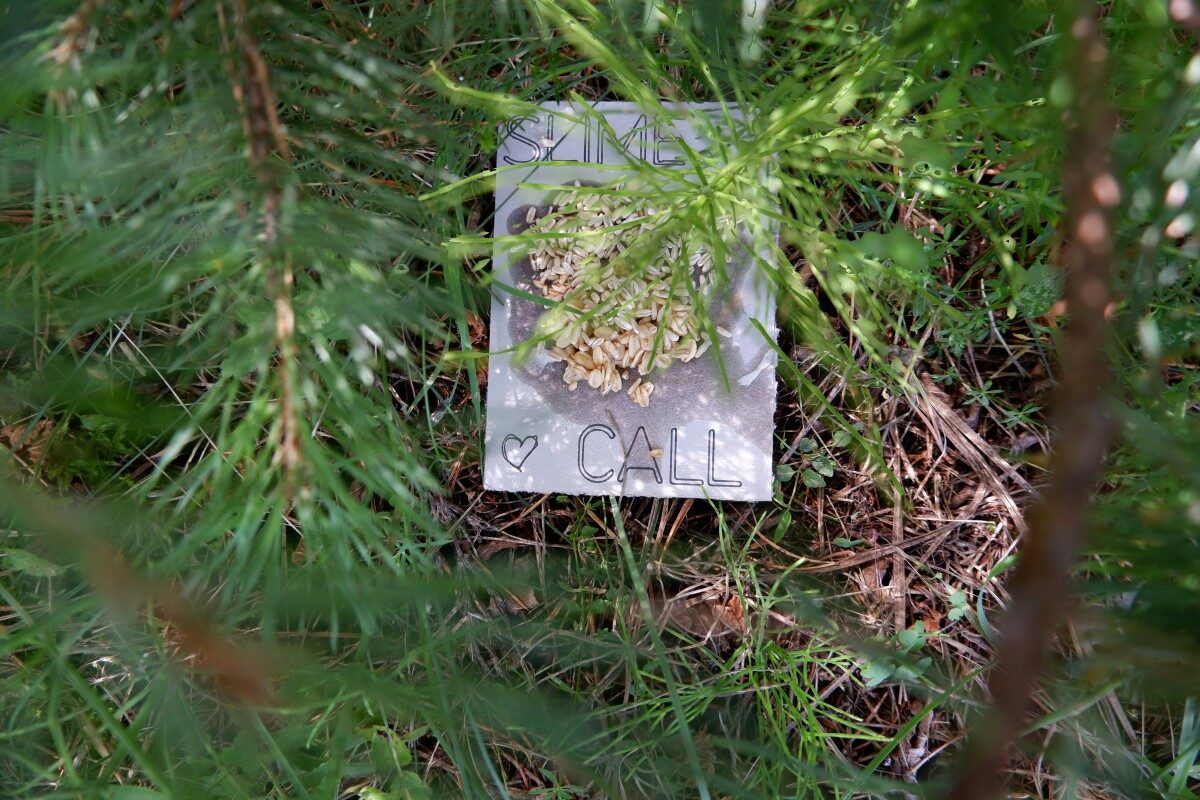
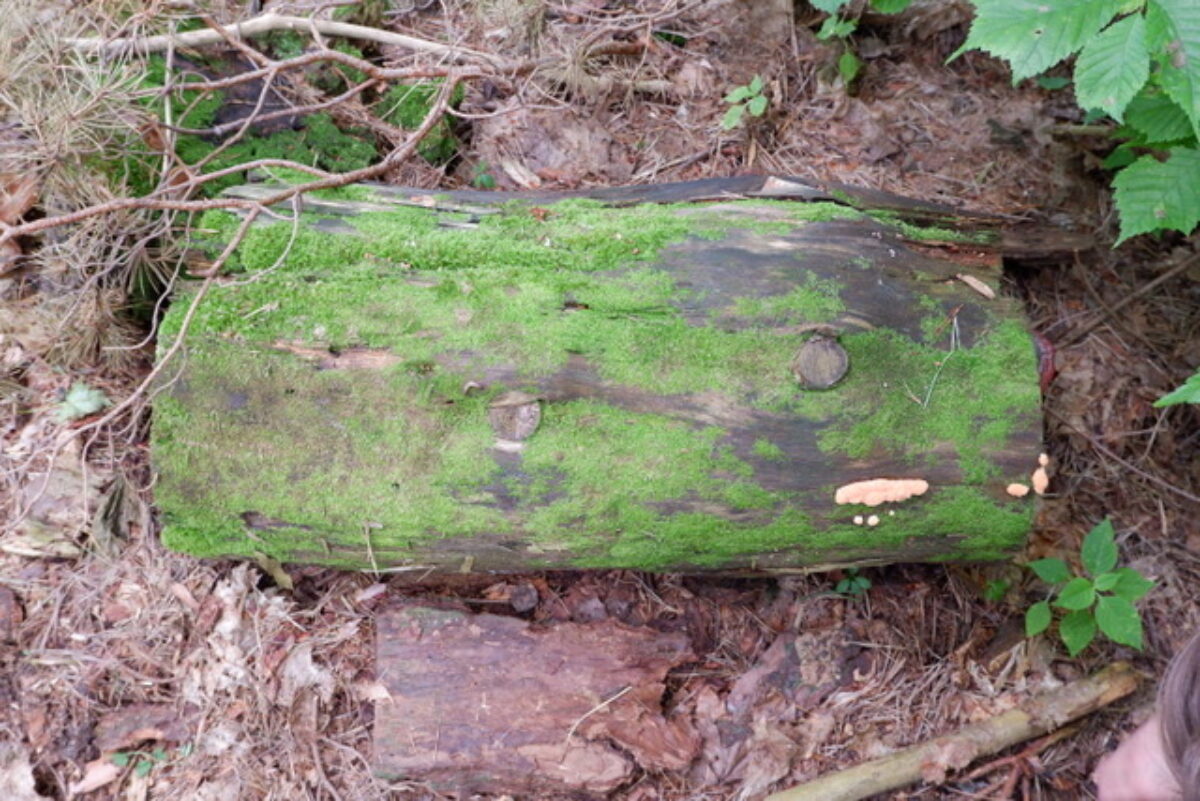
In our recent research residency we focused on logging on to our computer to write studio notes, looking at logs around us in the forest and logging on an experimental map a pathway through the forest in which we attempted to attract slime molds to us. While we did not attract slime molds to the slime calling cards we distributed throughout the forest, which we made with human companions, (covered in oats and honey – slime’s favorite lab food) we did end up spotting some slime molds for a few days when we encountered them on a log. Through traversing throughout the forest day after day visiting each of our slime calling cards, we allowed our sensoriums to deepen into another feeling-space – to sense the forest and to sense where and what slime molds might like to be or do.
Over time, through maintaining the juxtaposition of Slime Molds next to Algorithms we learn more about how they are similar and different. Considering how the colonial violences of algorithmic logics can be unmade, or considering if that is desirable or possible. And following and considering the queer ways that Slime Molds are organizing away from human forms of perception and recognition.

Why have you chosen this topic?
Working on Slimes and Algorithms is a way to work towards pluralizing what can come to be known as computational artistic research. Working on Slime Molds has been part of my work as an artist, which has to do with loving more-than-human companions of all sorts that through experience evade human forms of categorization and normalization. By becoming friends with more-than-humans that refuse these forms of capture, I am attending to the ways that we humans can learn to evade categorization and normalization which closes down ways of identification, understanding and being in and through the world.
This kind of thinking which unmakes categories and classifications is nearly unthinkable when it comes to bear on computation. Therefore, a different attunement to what computing is, can be or why it is useful must be developed and new ways of learning about computing beyond binary and fixed modes can be approached. This is a long term project of my artistic research which is accompanied by many companions who I have worked with and gushed on over time — like the work I’ve done with Romi Ron Morrison, Helen V. Pritchard and Eric Snodgrass on oracle(s) in which we together lovingly experimented with Black Feminisms and speculative computing: https://elegantcollisions.com/oracles; my long term appreciation and love of the work that PreCog Magazine (Florencia Escudero, Gaby Collins-Fernandez, Kellie Konapelsky) have done with interfacing intersections between feminisms & techno-sciences, which I have contributed to in and over and through time: https://precogmag.xyz/ and my long term admiration of the work of Possible Bodies (Jara Rocha & Femke Snelting) who I have worked with both in terms of placing and re-orienting the possibilities of togetherness in on/offline spaces: https://possiblebodies.constantvzw.org/.

What research methods do you use?
For this research residency, we chose to become students of slime molds as our primary method of research. This meant for us to consider how they move, what they like, how they have been studied and how they are opaque in their movings. We conducted a series of experiments throughout our time, for example, collecting some bits of rotting decomposing wood and taking it into our closet in the studio, keeping it moist, warm and dark – wondering if slime would emerge from these bits of nurtured (by us) earth. Another experiment we undertook was the crafting of ‘Slime Calling Cards’ called SLIME.CALL. In this experiment we remixed the protocol from Python, where when you want to ‘call up’ something the computational command one writes is .CALL – from here we created a series of calling cards on recycled cardboard and decorated these cards with oats and honey, the foods that in lab settings slime molds like to eat. Placing these calling cards in the forest, we regularly checked on them to get a sense of what slime might like – shifting our human sensorium to one far more slow, wet and slimy.
In what way did your research affect your artistic practice?
Our artistic research departed from a shared understanding of the interwoven contexts between academic-artistic research, meaning that the artistic practice emerged out of the academic research and vice versa – to construct them as separate would be false. Appreciating shapeshifting qualities of slime molds, my artistic practice refuses boundary drawing as a mode that replicates separation and colonial forms of capture, rather in this research residency we focused on what slime molds as ancient beings wanted to share with us, assuming that everything we needed to find would be there to find, and sometimes not seeking more is also about appreciating what is already there.
What are you hoping your research will result in, both personally and publicly?
The dismantling of the modes of computing that continue to exhaust the Earth and the Ghost Work labor that fuels contemporary colonial computing paradigms.
The appreciation of queer ecological practice that refuses categorical and binary thinking.
The understanding that plants and ecologies make our world possible, and for humans to move into more gratitude, reciprocity, joy and around this.