Based in Antwerp, Belgium
Website https://sarahvanmarcke.com
Research project From Walton Hall to Groot Schietveld: an artistic inquiry into the nature reserve as a layered entity
Location Luca School of Arts (researchgroup Photography Expanded)
Can you describe your research project?
In my research project I focus on the concept of the nature reserve. Where humans once had to protect themselves from nature, it is now nature that must be protected from humans. The reserve is a controlled and manipulated environment, designed to conserve or restore flora, fauna, and geological features. It bears the scars of the past while simultaneously pointing toward a possible, restorative future. That future is shaped through strict management plans or through rewilding—sometimes grounded in scientific insight, but just as often informed by nostalgia or romanticized notions of nature.
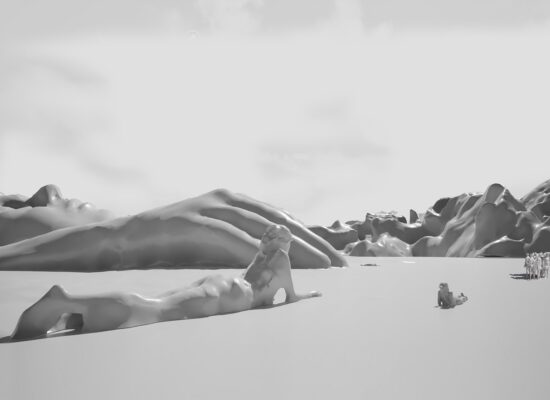
My research is structured around a series of carefully selected (former) nature reserves as case studies. The first is Walton Hall in the United Kingdom, possibly the world’s first nature reserve, established in 1826 as a walled estate to protect local fauna. Today, it has become a private golf club. This case study was on display at the Botanique in Brussels in June and July. The second case study – the research, which actually began this summer – focuses on the Groot Schietveld in Antwerp, a military domain that also serves as a nature reserve.
This project builds directly on previous work and can be seen as a continuation of earlier artistic research. Its foundations were laid in installations presented at DMW Gallery in Antwerp and at Concertgebouw Bruges. In both locations, I made site-specific installations based on self-created nature reserves – transforming the gallery space into a kind of artificial nature reserve, using all the plant life present in each building as a starting point.

Why have you chosen this topic?
I am drawn to nature reserves as sites full of contradictions—places that simultaneously evoke wonder, a sense of ecological urgency, and raise questions about exclusion, control, and violence. These spaces are never neutral. My perspective shifts constantly throughout the process: from admiration for the ecosystems to discomfort, anger, or sorrow when confronted with their colonial or militarized pasts or present. Public opinion around these areas is often deeply divided as well, both regarding their current state and their histories. There is no single way to look at them.
Within this context, my work explores the entanglements of capitalism, colonialism, gender inequality, and an instrumental view of nature. My first case study, Walton Hall—the world’s first nature reserve—revealed how these broader systems of power have left a deep imprint on both the land and its narratives.
At the same time, I’m fascinated by the diverse and often unexpected stories that emerge through the research. In the case of Groot Schietveld—a military domain that also functions as a nature reserve—I’m particularly interested in how people and non-human species inhabit and even reclaim the space, whether through a large illegal rave that once took place there or through the thriving population of vipers. These parallel realities challenge dominant readings of what these places are—or should be—and open up space for more layered, polyphonic interpretations.

What research methods do you use?
My process always starts through direct engagement with the site itself, in this case nature reserves. I walk through them, photograph, film, and write. I engage in conversations with people I encounter and observe how these places influence me and shape my way of working.
Almost simultaneously, I begin delving into archives and reading about the sites. Informed by visual and written archival materials, as well as both well-known and obscure stories collected from or about specific protagonists, I search for meaningful shifts in, and interpretations of, the history and the present state of the site. Through this, I attempt to grasp and articulate the genius loci—the spirit of the place.
The insights that emerge from these different research phases form the basis and starting point for new work, which takes shape in various media: photography, video, installation and, more recently, text. However, the form is never predetermined—it is guided by the nature of the research and the resonance of the site itself.

In what way did your research affect your artistic practice?
This research is being conducted as part of a doctoral trajectory at LUCA School of Arts, within the research group Photography Expanded. Although research has always been a central component of my artistic practice, the long-term nature of this PhD allows me to engage with it more intensively and without the immediate pressure of producing artistic output. This space for slow, in-depth work was often hard to come by in previous contexts—whether due to external expectations or my own hesitation to claim time for such processes.
One of the most valuable aspects of the PhD are the regular peer discussions between its researchers. Not only is their critical view of my work priceless, but also the discussions about the overlaps between their work and mine – or even the aspects where there is no overlap – are very inspiring.
The first case study within this trajectory resulted in an essayistic film—a medium that was entirely new to my practice, and one I am grateful to have discovered.

What are you hoping your research will result in, both personally and publicly?
I usually begin without a clearly defined end result in mind, and I rarely consider my work as a final conclusion. What I do hope for is that the project allows me to take new steps within my own practice—and, above all, that I continue to learn: about our society, our relationship with the living world, and ways of thinking about and reflecting on the ecological crisis. I aim to draw connections, gather stories and experiences, and invite others to engage in this process of thinking alongside me.