Based in Copenhagen, Denmark
Research project New Connections: Queering the Radio Voice
Location The Phd is anchored in a bi-institutional position between the Royal Danish Academy of Fine Arts and University of Copenhagen. It is funded by the Novo Nordisk Foundation. I am working in the Laboratory for Arts Research.
Can you describe your research project?
In my research project I am investigating the relation between voice, podcast, sound and performance. I started my research in 2020 where I was initially considering doing full-time podcast. For various circumstances, I made two commissioned podcasts for the Danish art institutions Art Hub and Rønnebæksholm instead. These case studied were made in 2021 during the pandemic. Accordingly, I have been involved in making songs and performances, and my practice has moved more towards voice theory, where I mainly sing in performances, rather than radio art. Parallel with this, I am analyzing theoretically what I made in the podcast commissions, and how this relates to my more general interest in voice and performativity. The PhD project is funded by The Novo Nordisk Foundation and institutionally anchored at The Royal Danish Academy of Fine Arts, where I have an office at the Laboratory for Arts Research.

Why have you chosen this topic?
I have a long-lasting interest in sound, and a background in experimental music / composition / sound art. It seemed natural to expand this interest into radio / podcast art, and to question the boundary between the two. Increasingly, my main research interest has become voices. Although I mainly think of my project as an artistic research project, I am inscribed at Visual Culture at University of Copenhagen, and this influences how I think of my research. In Denmark, artistic research is not recognized as scientific research, which is why the rather awkward setup between a private foundation, a university and the art academy is how the PhD is structured. It has many bureaucratic disadvantages, but also some cons, which relate to being in touch with the PhD Students and the Faculty at the university department for art history and visual culture. Briefly explained, it is necessary to have an affiliation to a university to validate the research as scientific – the Royal Danish Academy of Fine Arts does not have the mandate to give the PhD degree.
What research methods do you use?
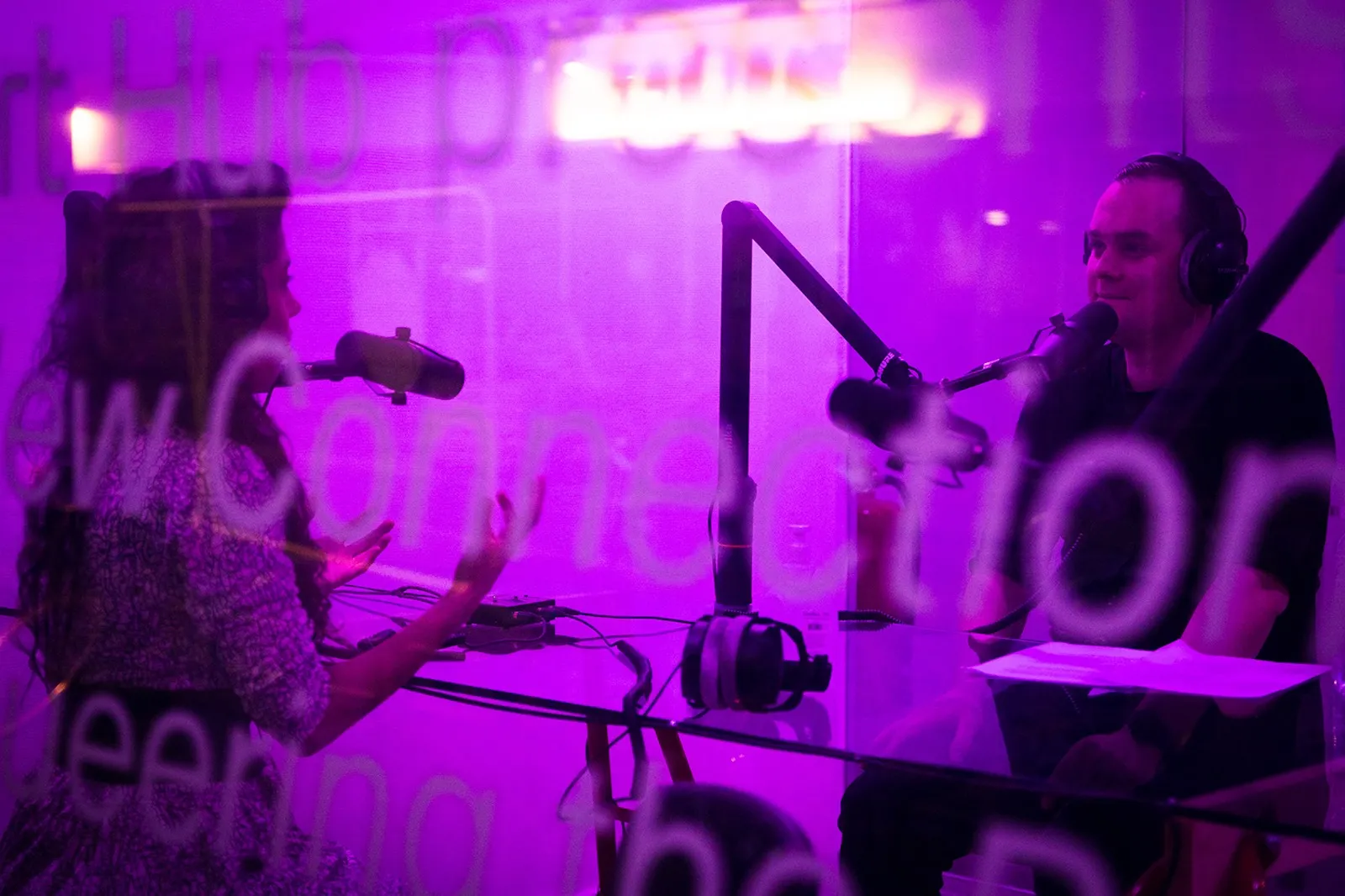
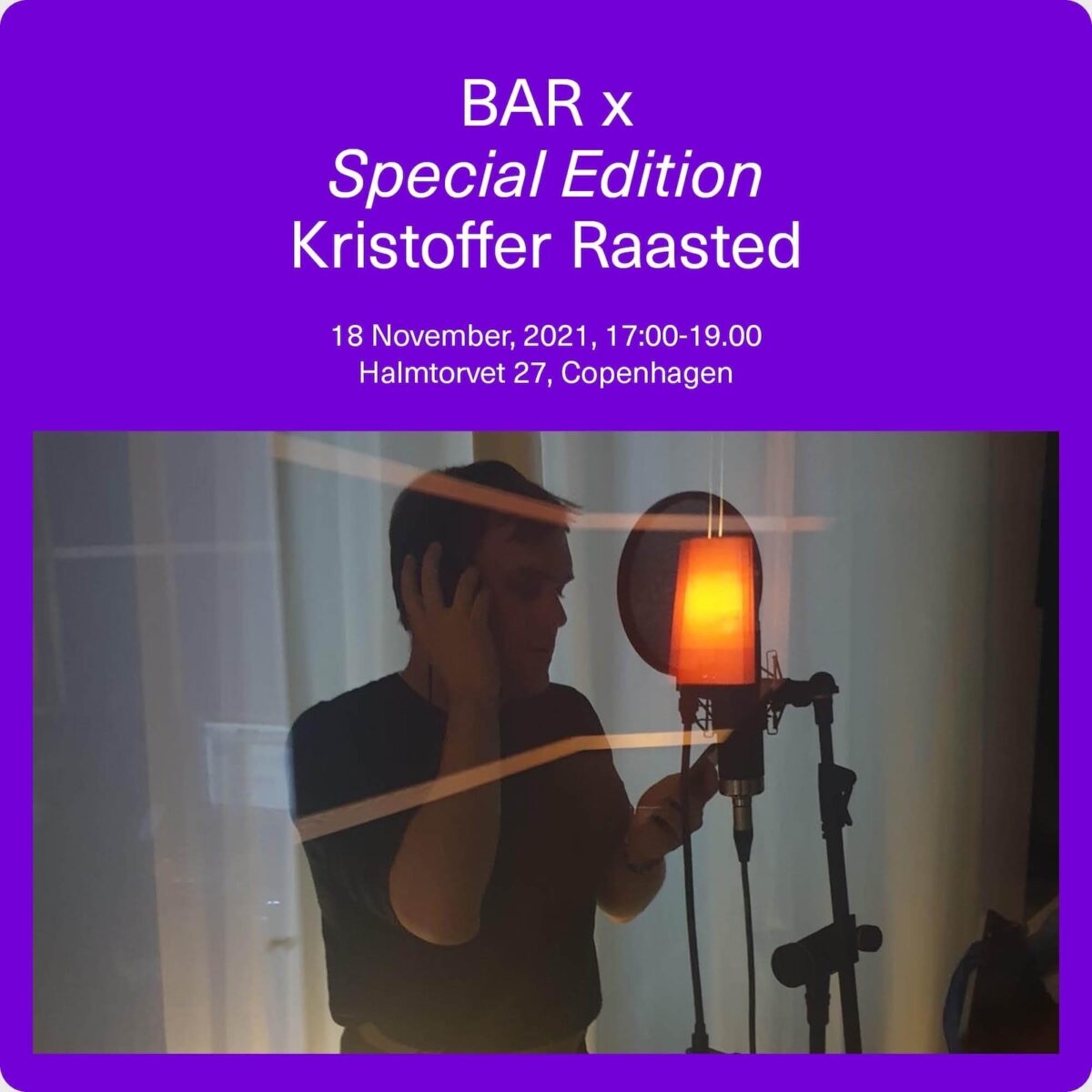
In the podcast, that are accessible on Spotify (search for New Connections: Queering the Radio Voice), I engage in conversation with colleagues on the Danish art scene – artists, curators and art theorists. In these conversations, which are structured like informal interviews, the conversation is used as a research tool. I think of the podcast as a platform for establishing new connections between the research areas I set out to concentrate on. In the voices of the guest, there is a lot of information accessible – the conversations mainly revolved around the practices of my guests (except for a later programmed “flip” episode, in which I visited the podcast station as a guest), and I used a tool from radio called a run-down to structure the conversations. In other words, I prepared beforehand and used questions as a way to direct the conversation. It was my debut as a radio host – and I fortunately had a good setup with a sound engineer, a curator with a background in radio and the team at Art Hub to make the podcast. In this way, it is a collaboration with an art institution, and is also shaped by the expectations and agendas of Art Hub.
In what way did your research affect your artistic practice?
In many ways, I think my research is my artistic practice. Since it is an artistic and practice-based research project, it seems increasingly difficult to draw the line between what is research and what is artistic practice. One thing that changed after I got the PhD stipend is that I began reading and writing more. Books have always been very important for me, but in periods I have moved into other processes, material and so on, making music rather than reading – but with the PhD my practice of reading and writing is somehow again a very important part of my work as an artist, and I have come in the habit of reading many books and writing regularly.
What are you hoping your research will result in, both personally and publicly?
I hope I end up getting the degree. After that, it is a bit uncertain what comes next. I have made the PhD rather early in my career, and in this way it is stil very open what direction I will move in later on. I hope my research sparks an interest, and that the podcast will find interested listeners in the future – I also think of it as a type of documentation of some perspectives of artists practices in a local context, which I think of as an under prioritised area in the media landscape that I encounter in my daily life. Overall I have been very happy about making a research project, and I hope to continue my career as an artist and researcher later on – time will tell.