Artists Agnes Scherer
Date 17-09024 – 02-11-2024
Curator Eva Birkenstock
Venue Meyer*Kainer, Vienna
Text Eva Birkenstock
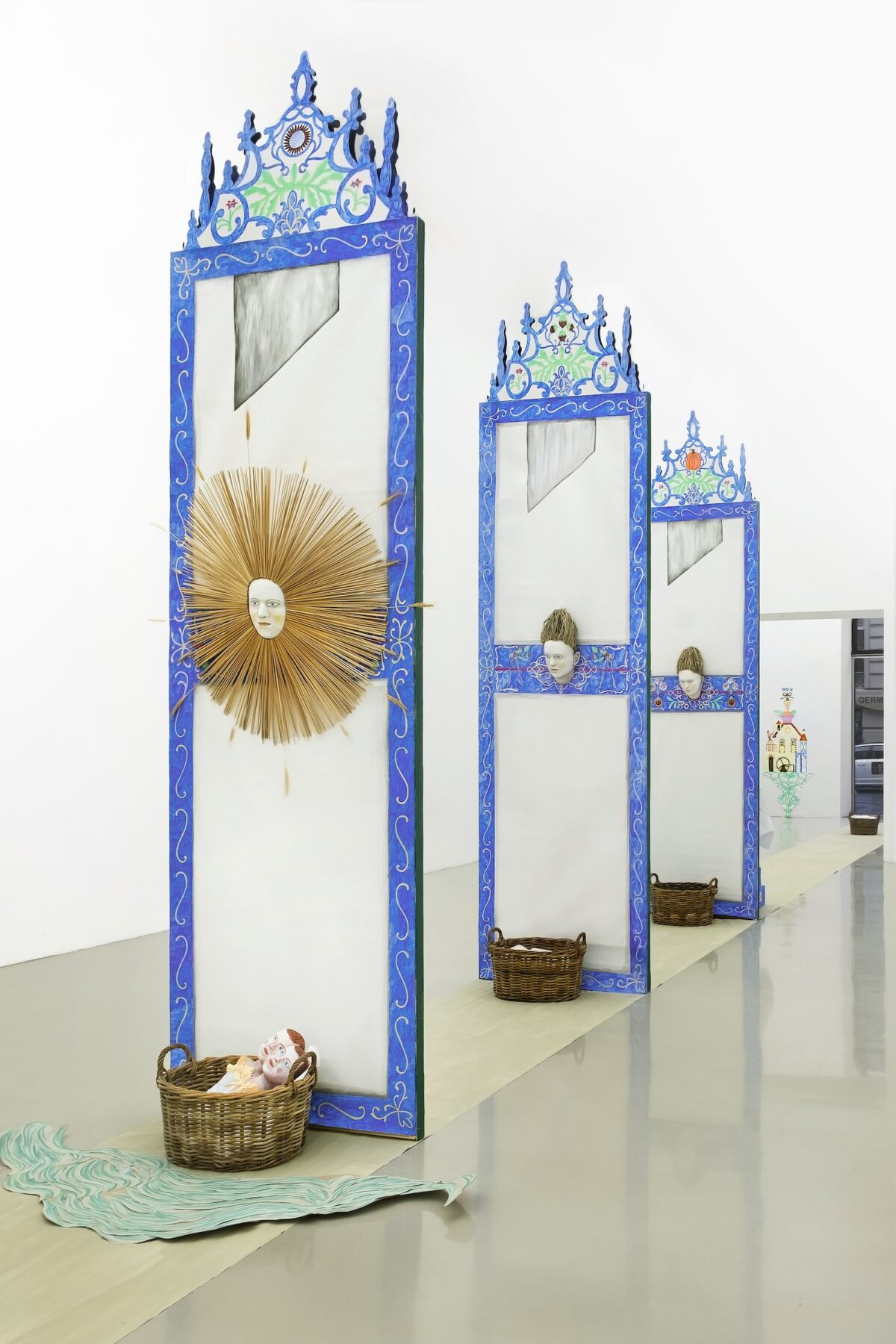
At the entrance, a basket of eggs and painted wall ornaments refer to the fully functional farm village, the so-called “Hameau de la Reine”, recently restored with the support of the House of Dior, which the queen had constructed in the gardens of Versailles in 1783 to playfully explore a rustic lifestyle with her children and selected guests. The paintings depict Marie Antoinette in the role of a dutiful peasant woman. A ribbon of paper runs through the installation like a carpet. Serving as a kind of cosmic gateway, Scherer’s folk-art guillotine is repeatedly breached by the queen in order to project herself, miraculously unharmed, into new idylls: as a shepherdess tending lambs or, in a Stone Age idyll, as the tattooed enchantress of a wild cow.

In Strawfires, the narrative of decapitation is not addressed as an end in itself, but rather as an ongoing process of transformation and a repetitive sequence of defiance and renewal, as represented by the symbolically freighted head-catching baskets of the guillotine. The final piece depicts a basket on the banks of the Tiber containing the abandoned infants Romulus and Remus, who would later be found and raised by a swineherd. They were thus able to claim the throne as adults, bringing to fruition precisely that which was to have been prevented. Marie Antoinette is emblazoned above them in a sun-like royal corona.
Installation
Mixed media
Variable dimensions
In contrast to glorifying perspectives on the French Revolution, Strawfires offers an ambiguous portrait of these events. The title refers on the one hand to the recurring overwriting of revolutionary agendas by neo-feudal demands for power, privilege, and profit maximization.

And so, just 12 years after the abolition of the monarchy in France, the Napoleonic Empire was proclaimed. On the other hand, the title refers to a romanticized dream of egalitarianism within the broader societal context—a dream to which the pretense of simple lifestyles, detox rituals, or regular retreats to remote ‘cabins’ for mental and physical cleansing pay little more than lip service. Marie-Antoinette’s village project was inspired by her serious engagement with the ideas of Jean Jacques Rousseau and the vision of a natural, egalitarian society.

Installation
Mixed media
Variable dimensions
Agnes Scherer (born in 1985, Germany) lives and works in Salzburg and Berlin. She studied painting at the Kunstakademie in Düsseldorf with Peter Doig and Enrico David.
Scherer’s work develops unique forms of presentation which bring together paintings and handmade artifacts, generating large-scale and holistic installations. Scherer thus creates complex pictorial work that resists immediate objectification and commodification, instead demanding from viewers a heightened level of focus and engagement. Throughout her artistic practice, she interrogates power relations and their underlying psychologies. Drawing from analyses of art history, anthropology, and cultural history, Scherer subverts artistic strategies that originally served the consolidation of power. Using anachronisms and representation of universally known symbols, her work often illustrates the uncanny ways in which historical systems, economies, and societal roles are reflected in the present.

Acrylic on canvas, Ink felt pen on paper, 109.7 x 84 cm