Based in Melbourne, Australia
Website https://ioannasakellaraki.com
Research project Archiving the Disaster: Preservation, Separation and Encounter
Location RMIT University, Melbourne, Australia
Can you describe your research project?
Archiving the Disaster: Preservation, Separation and Encounter is a practice-led PhD study that utilises philosophy and literary theory to inform an expanded photographic art practice through writing and making. The inquiry is developed through a series of encounters with The Writing of the Disaster (1986) by French literary thinker Maurice Blanchot that shape a selection of fictocritical writings and artistic explorations in the nexus of photography, embroidery, and collage work. Emerged in the intersection of geographies and material practices, the work reveals my uneasy process to narrate the secret findings in my late father’s maritime archive through the historic, symbolic and material interpretations of the pearl. At first encountered in the form of a pearl necklace, my father’s, unknown to me, ex-wife appears to wear in his records, it becomes the method of inquiry for the reciprocal exchange and anamorphosis of maritime histories between my homeland Greece and my current place of residence in Australia’s west; the ‘Pearling Capital of the World’ from over a century ago. Navigated through the continuous reconfiguration of the physical and conceptual conditions of the archive, this is an interdisciplinary study that seeks to uncover novel relationships of image and thought in relation to the disaster forming the meeting ground between creative practices, the personal and the philosophical.

Why have you chosen this topic?
To answer this question, I need to go back to 2018 when I entered an amphitheatre at the Royal College of Art in London, where I was then studying for an MA Photography, and through a session in Critical and Historical Studies, given by tutor Jonathan Miles, I was introduced to the work of French Literary thinker Maurice Blanchot. Since then, and with my practice- led PhD as a departure point, I have thoroughly engaged with interdisciplinary critical theory in relation to visual arts in my ways of pursuing research across diverse discursive and visual registers. More critically, my focus on Blanchot’s work has navigated a series of attempts to make several associative links between language, the image and the disaster departing from the main question in his book: How can we write or think about the disaster that is an infinite threat when by its very nature it defies speech and compels silence? And his conclusion that we cannot but writing is the patient response of this helplessness.
What happened in the in between is that this helplessness confronting the limits of language and thought in relation to the disaster was experienced very strongly through my own making and it stayed with me for a while as I was by that time finalising my long- term project The Truth is in the Soil, after 5 years of working on it, what came to become my first monograph published by GOST Books (London, 2022). And I mention this as this is the first time that I developed a conversation between my practice and Blanchot’s work so I consider this the second departure point of this research study. Indeed, the first phrase in my monograph reads ‘’I continue to seek for a disaster that has not happened yet, like it would take care of everything I remember forgetfully, again the outside.’’ And as you can imagine I still continue to seek for it…
But what is so interesting about this act of seeking of the Blanchotian disaster? I would like to begin by saying that I am interested in how by writing the disaster, Blanchot reflects on the disaster of writing too, through its own displacement and interruption in history and literature. Interestingly, the ineffable of the disaster is only named in the text through its multiplicities, as the fragmentary, in his writings, always evades naming and that is exactly how it performs its work by escaping.
Having these ideas in mind and going back to my own practice, in my work with photography, collage and embroidery, I am also interested in exploring the scattered, the interrupted and the incomplete, working through omissions and discovering new ways of reconstructing the past by looking into history not as a fixed or objective reality, but a dynamic and contested process of meaning-making.
With regards to my work with archival research, I am also interested in the ways in which my seeking process has been a shelter and a destination itself and the places this research has taken me are both inside the archive but also echo places outside of it, referent to its histories which are hybrid places themselves. This practice- led project is my most successful attempt to achieve this to date.

What research methods do you use?
My methodologies spring from the ways in which being an archive maker, user and thinker, all at once, has allowed for an expanded field of knowledge in the crossroads of philosophy, literary theory and art practice. Questions around how to engage, dismantle and transform those spaces come to form a methodological framework that is primarily concerned with ideas on repetition, fallibility and fragmentation of a practice circling around disasters, pearls and archives as the temporary anchors of its conceptual and material selves.
In this context, I aim at answering my research question through a diagrammatic method, a non- linear methodology that speaks about a multiplicity of relationships in constant flux in the intersection of thought and action. What I come to call a circuitous diagram as part of my approach is not a mere representation of the path between reality and imagination, a passage from the personal archive to the historical one, but a way of intervening in them, creating new possibilities and relations, based, not on a hierarchical logic, but rather on a multiplicity of connections and direction as generated through my practice itself.
Inspired by Gilles Deleuze’s use of the rhizome, which is a plant that grows horizontally, branching out in different directions, without a single root or center, ‘’the disaster bereft of a center’’ (Blanchot, p. 11) as a metaphor to describe a mode of knowledge production that is open, dynamic and experimental, I come to create my own methodological topos of inquiry through the concentric growth of archives, pearls and disasters. By operating in between-spaces, embracing a fluid topology constantly making and unmaking in the process of seeking, gathering and modifying, I come to highlight the ways in which the workings of the disaster grow in the shadow of one another, and equally, an array of themes and concepts drawing attention to the fragmentary, the thought and the exigency of discontinuity, the radically exterior and the self as Other, are explored.

In what way did your research affect your artistic practice?
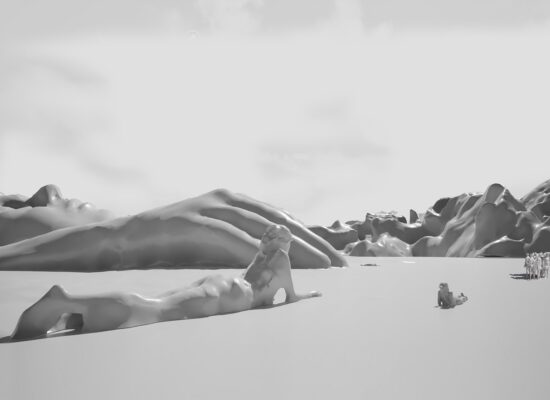
By using my work realised with archives, pearls and disasters to create a shared space of understanding between the Blanchotian disaster and the archives researched, I have allowed for an extensive insight into the ways in which the Blanchotian disaster became my form of navigation towards making. Ultimately, the archives I engage with through this research do not only become the critical frameworks and conceptual mediums for the realisation of new works in relation to the disaster, but also allow me to experiment with the methods of spatial analysis and auto theory challenging my practice towards new directions. This has been a performative process of working both with made and with already existing images but through a novel, and unexpected, relationship between space, theme, plot and materiality allowing me to reshape my relations to memory, history and identity through writing and making as seen in the artworks shared alongside this interview.

What are you hoping your research will result in, both personally and publicly?
Personally, I would like to delve even deeper into Blanchot’s work and creative practice research after the completion of my PhD in a few months’ time. I wish to further inquire about how the Blanchotian disaster does not only operate as a critical framework but by being extended, modulated and transgressed in relation to different types of archives can continue to creatively synthesise new composites and assemblages of interpretation. I present part of this work in ARCHIVO International Conference on Photography and Visual Culture: Reframing the Archive on the 27th of September 2024 and would wish to be given the opportunity to continue to present this work through different portals. Eventually, I would like to publish a photobook including part of my critical reflections and fictocritical writings as my next publication.